
About
The raw material tripled. The drink didn’t change.
Japan nearly tripled its production of tencha — the shade-grown leaf that becomes matcha — over the decade to 2024. The price rose anyway, and it kept rising while ordinary green tea barely moved. Every café serving matcha felt it, and most are still buying the same grade they always did.
NOT THE MATCHA exists for the part of that bill you should not be paying: the ceremonial premium on a drink that goes into milk.
A matcha problem, not a tea problem
Japan produced 1,969 tonnes of tencha in 2014 and 5,336 tonnes in 2024 — roughly 2.7 times as much, according to the agriculture ministry. That is not an industry standing still.
MAFF, Tea Situation Report, October 2025 (data: National Federation of Tea Producers).
Prices rose anyway — and only for matcha. Over the five years to 2024 tencha climbed about 51% while ordinary sencha moved about 10%. Then, from 2024, the Kyoto auction went vertical: ¥14,127 per kilogram in 2026, the highest in ten years.
Tencha crept up for years while ordinary green tea barely moved. Then, from 2024, the Kyoto auction went vertical — ¥14,127/kg in 2026, the highest in ten years.
- Tencha — Kyoto opening auction
- ¥4,800 (2024) → ¥14,127 (2026)
- Tencha — national crude tea price
- ¥2,170 (2020) → ¥3,278 (2024)
- Sencha — national crude tea price
- ¥1,090 (2020) → ¥1,197 (2024)
Two markets, same unit, split at 2024. Left of the divider is the crude-tea price across Japan, which is published up to 2024. Right of it is the opening auction at Uji, which sits at the premium end, moves first, and is the only tencha price reported for 2025 and 2026. The two are not joined into one line because they measure different things — the step at 2024 is the gap between those two markets, not a jump in price.
View as table
| Year | Kyoto auction | Tencha, national | Sencha, national |
|---|---|---|---|
| 2020 | — | ¥2,170 * | ¥1,090 * |
| 2021 | — | ¥2,600 * | ¥1,290 * |
| 2022 | — | ¥2,800 * | ¥1,270 * |
| 2023 | — | ¥3,140 * | ¥1,220 * |
| 2024 | ¥4,800 * | ¥3,278 | ¥1,197 |
| 2025 | ¥8,235 | — | — |
| 2026 | ¥14,127 | — | — |
* Not a printed figure. The 2020–2023 national prices are read from the published chart’s own plotted coordinates, calibrated against the two printed 2024 values. The 2024 auction figure is what the Kyoto Shimbun’s reported 1.7× rise into 2025 implies; no number was published for that auction, so the segment leading to it is dashed and its marker is open.
National crude-tea prices: Norinchukin Research Institute, “The matcha boom and the rise in sencha prices” (May 2026), from Japan Tea Central Council data; the 2024 values match MAFF’s Tea Situation Report of October 2025. Auction figures: JA Zennoh Kyoto, via Shokuhin Shimbun and Kyoto Shimbun.
The leaf is not what you are paying for
Tencha averaged ¥3,278 a kilogram across Japan in 2024. That is about ¥3.3 a gram for the raw material. Walk into a shop and a tin of matcha sells for many times that per gram — the difference is milling, packaging, retail margin, and the word “ceremonial” on the front.
Some of that is real work and worth paying for. Most of it does not reach a customer drinking a sweetened iced latte. That gap is the entire reason this company exists.
Kyoto moved hardest
The 2025 harvest repriced everywhere, but not evenly. Kyoto’s tencha — the matcha leaf — rose the most.
2025 crop against 2024. Kyoto: JA Zennoh Kyoto opening auction, ¥8,235/kg, reported as 1.7× the previous year. Kagoshima and Shizuoka: MAFF, Tea Situation Report, October 2025. The Kyoto figure is tencha specifically; the other two are first-flush tea of all types, so they are not a like-for-like comparison — they are the closest published numbers for the same season.
Why it happened, and why it will not unwind
Tencha is shade-grown and harvested once a year, overwhelmingly in a handful of Japanese regions. Growers have responded — national tencha production went from 1,969 tonnes in 2014 to 5,336 tonnes in 2024 — but new tea fields take about five years to reach full production, and the farming workforce is ageing. Supply is close to fixed in any given season, and it cannot be turned up quickly.
Global demand has grown for more than a decade and shows no sign of reversing. When fixed supply meets rising demand, price is the only thing that can move — and record heat in the core growing regions has made the harvests smaller, not larger.
This is not a spike that corrects. Plan on the assumption that ceremonial-grade matcha stays expensive.
Where we sit
THE MATCHA is Kyoto, Uji, ceremonial grade — whisked with water and drunk on its own. It is genuinely special, it was never meant to be cheap, and if you serve matcha that way you should buy it and charge for it. We are not arguing otherwise.
What we will say is that almost none of what makes it expensive — the long shading, the earliest pick, the slow stone milling — survives contact with milk, ice, and sugar. Paying a ceremonial price for a latte is not a splurge. It is a rounding error you repeat several hundred times a week.
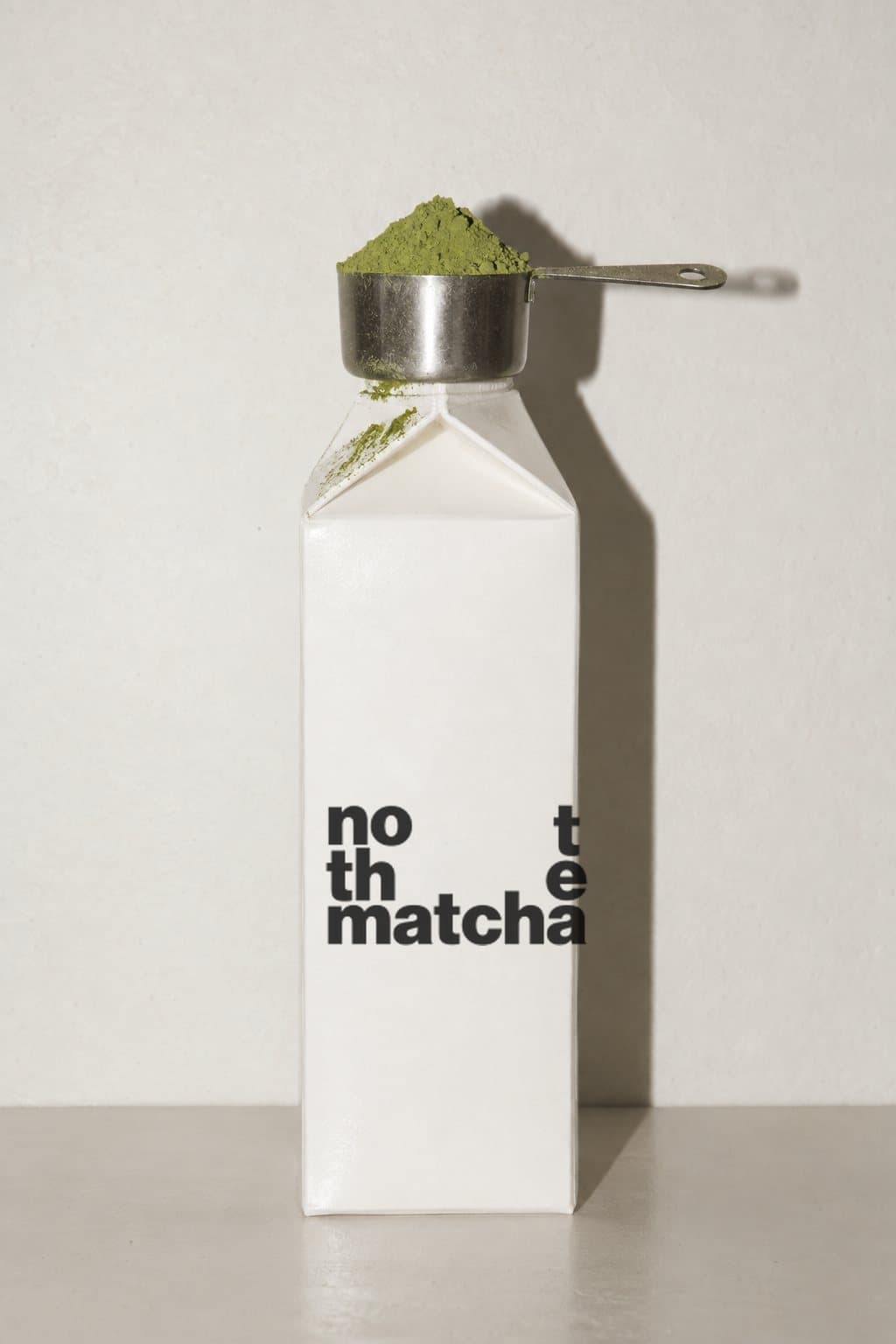
NOT THE MATCHA is the other half of that market: matcha selected for the job it actually does, priced so it can stay on the menu.
Chosen in Japan
Affordable matcha raises a fair question: who actually chose it? Cheap matcha reaches the market from a lot of directions, and most of the brands selling it are not close enough to the source to tell you much about it.
NOT THE MATCHA is run by a Japanese company. We are in Japan, we buy directly from Japanese producers, and we select against a single test: does it still taste clean in a latte, at a price a café can serve every day. That is a narrower question than “is this the finest matcha available”, and it is the one that decides whether matcha stays on your menu.
Today we list three: a premium matcha from Uji for the drink where origin is the point, and two culinary grades from Nara built for milk drinks at volume. We are also evaluating Chinese-origin matcha, and we will say so plainly here if and when we bring any to market.
We publish every price. Then you taste it.
Wholesale prices for every size are on the site rather than behind a quote request, because price is usually why you are here. Every matcha has a 20g sample, so the last word belongs to your own recipe rather than to this page.